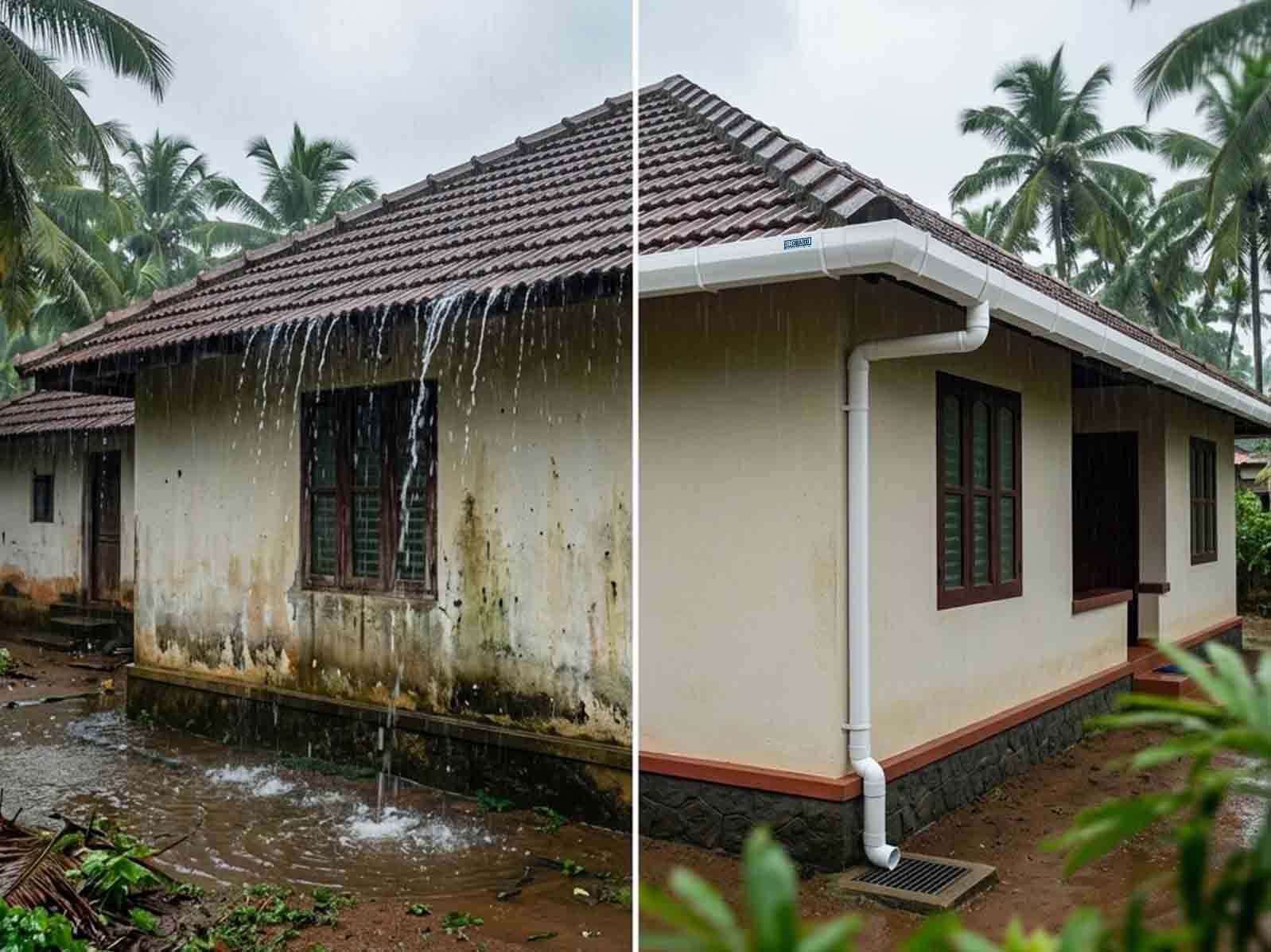

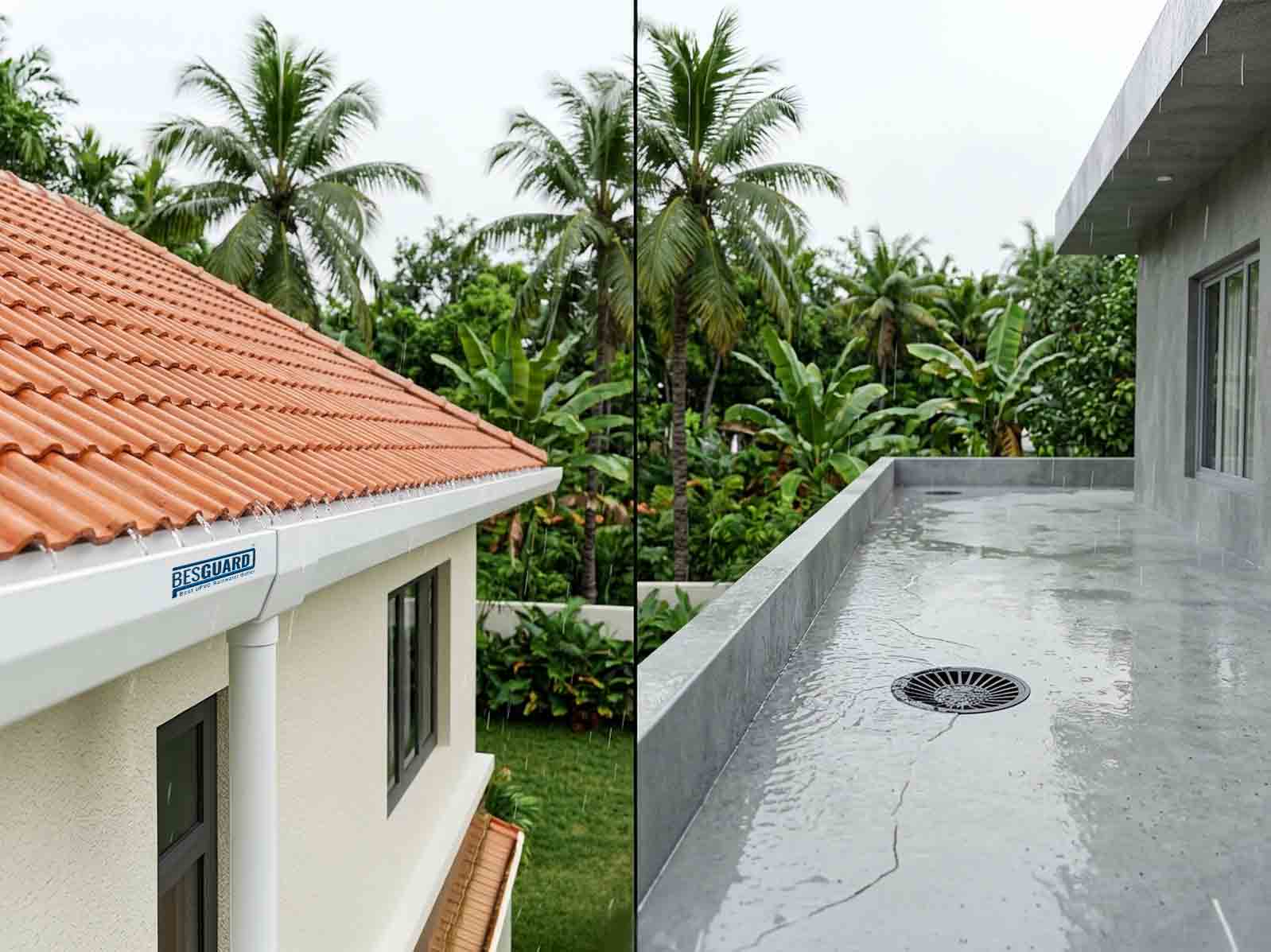
For most sloped residential roofs, a rainwater gutter is the more practical drainage solution, while roof drains are generally better suited to flat or low-slope roofs where water collects on the roof surface. The right choice depends mainly on roof design, rainfall intensity, drainage points, and how efficiently water can be directed away from the building.
For Kerala homes, where heavy monsoon rainfall can deliver large volumes of water in a short period, choosing the correct drainage system is particularly important.
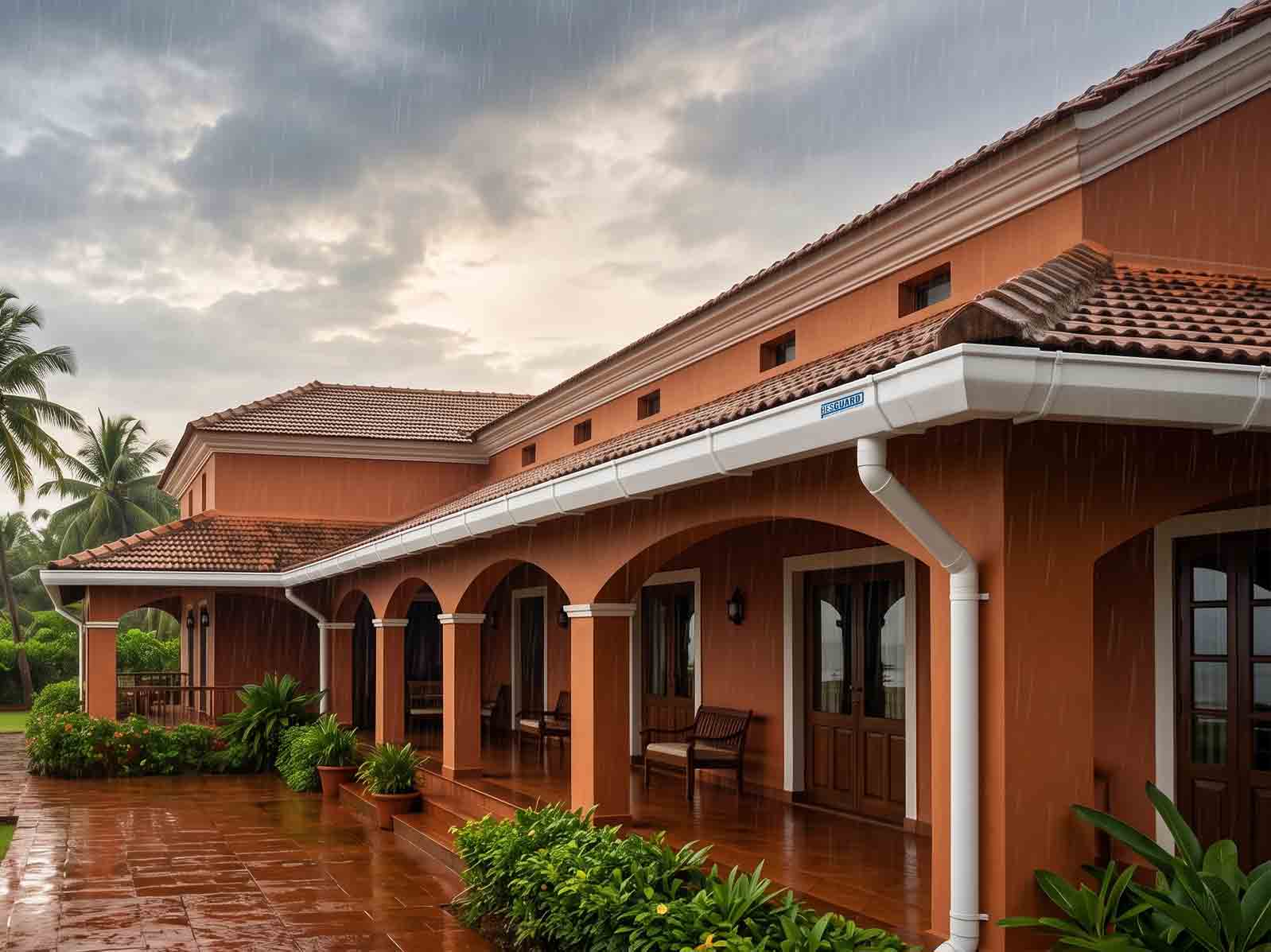
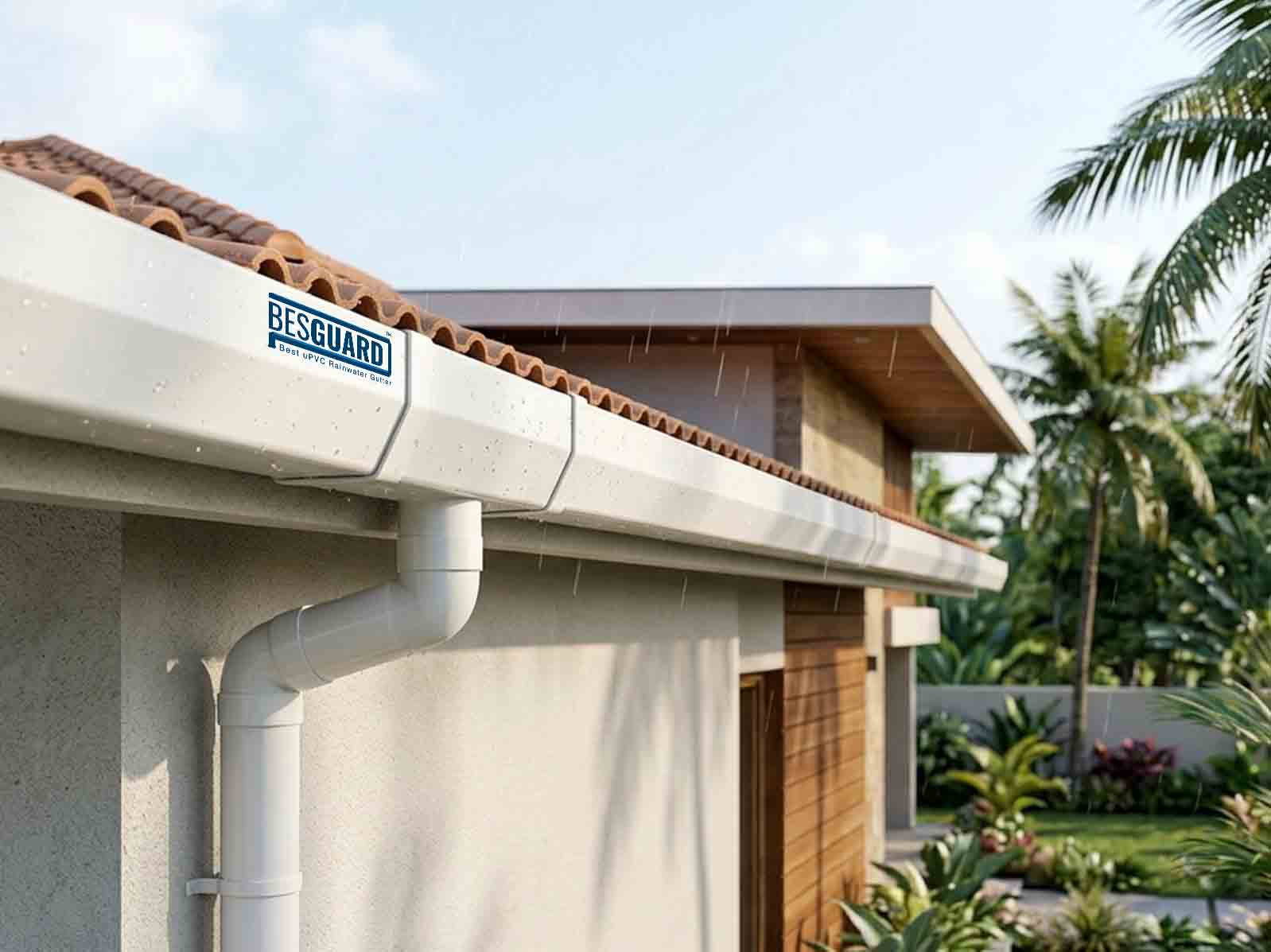
A rainwater gutter is installed along the edge of a sloped roof. It catches water as it runs off the roof and directs it toward a running outlet and downpipe.
A roof drain is installed at a drainage point on the roof itself. It collects water from the roof surface and carries it through a pipe, usually inside or alongside the building.
The basic difference is:
Gutter = collects water at the roof edge.
Roof drain = collects water from the roof surface.
For a conventional sloped residential roof, a rainwater gutter is usually the better choice.
Sloped roofs naturally direct rainwater toward their edges. A gutter captures this runoff before it reaches the walls and channels it through downpipes.
This makes gutters particularly suitable for:
A properly sized uPVC gutter in Kerala can provide continuous collection along the roof edge without requiring drainage openings through the roof surface.
Roof drains are generally more appropriate for flat or low-slope roofs where rainwater does not naturally flow toward an external roof edge.
They are commonly considered for:
A flat roof still needs a suitable slope toward its drainage points. A roof drain cannot compensate for poor roof grading or inadequate drainage capacity.
Kerala's heavy rainfall makes drainage capacity particularly important.
A drainage system must move water away from the roof quickly enough to prevent:
For a sloped Kerala home, an appropriately sized rainwater gutter provides a simple external route for collecting and directing roof runoff.
For a flat roof, properly positioned roof drains may be more suitable.
The roof design should determine the drainage strategy - not simply the type of drainage product available.
External gutters generally have an important maintenance advantage: the drainage route is visible and accessible.
A homeowner can inspect the gutter, running outlet, and downpipe for leaves, dirt, and blockages.
With internal roof drainage, access to pipes and drainage points can be more difficult, particularly when a blockage occurs inside the system.
However, gutters still require periodic cleaning. In Kerala homes surrounded by coconut, mango, rubber, and other trees, leaves and flowers can enter the gutter and should be removed before they accumulate.
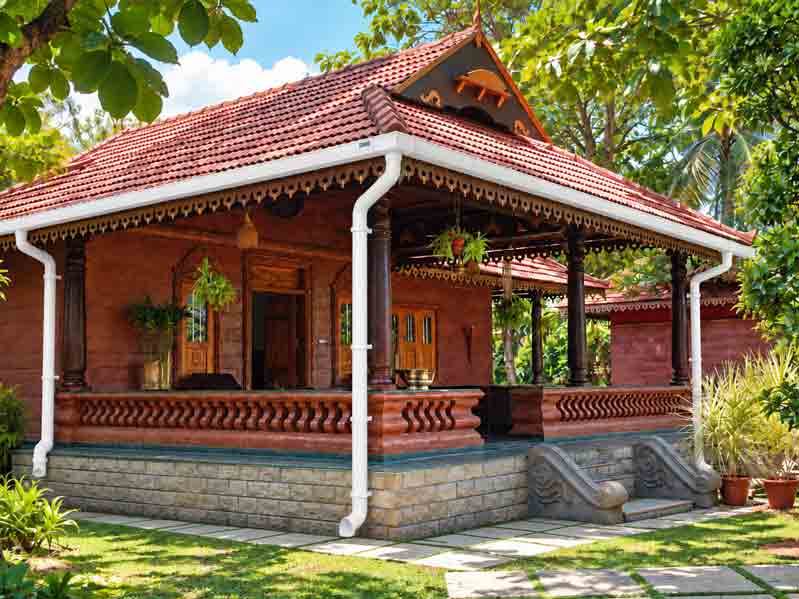
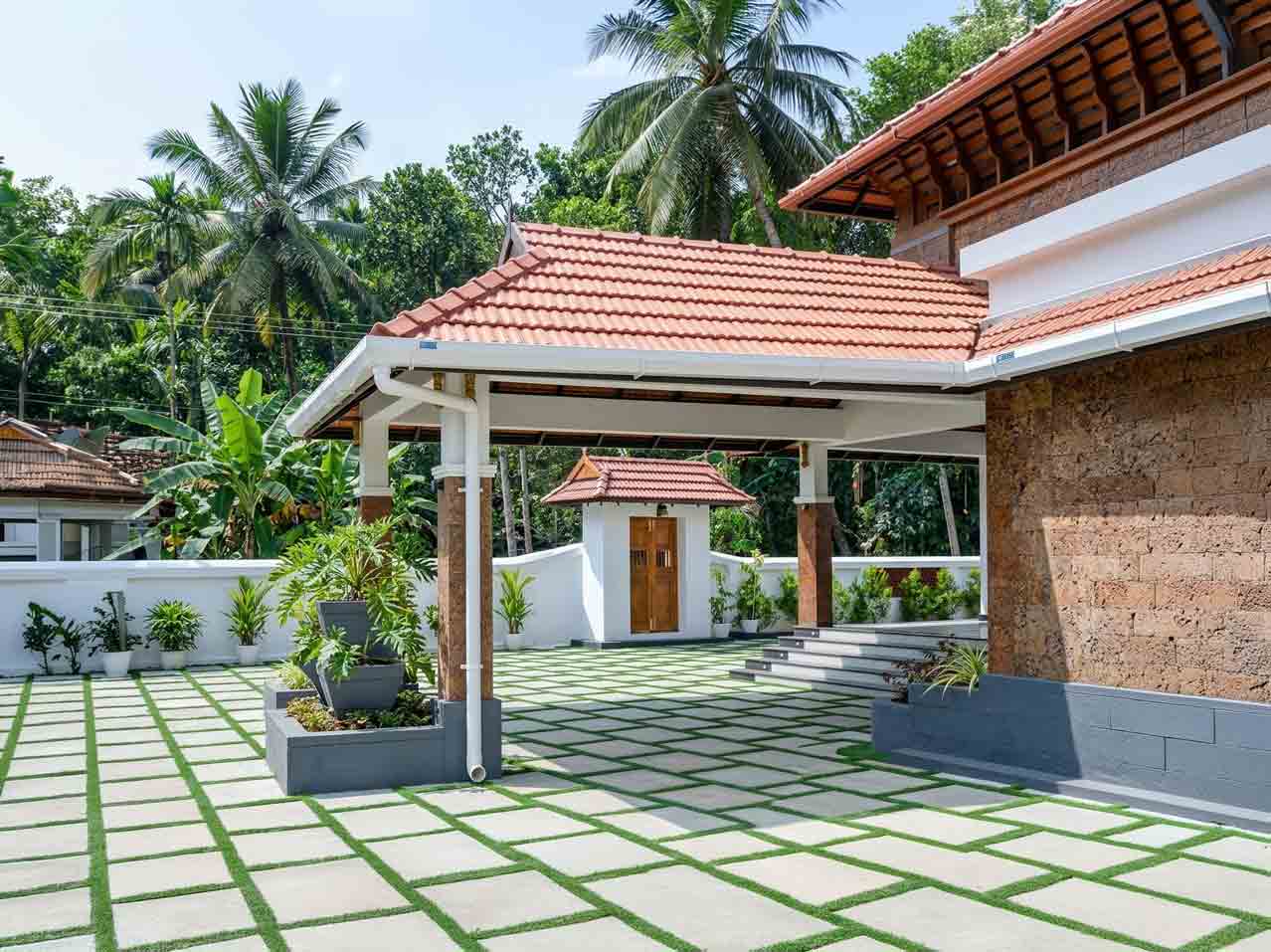
For a traditional Kerala tiled roof, an external rainwater gutter system is generally the more practical choice. The sloping tiles naturally direct water toward the roof edge. A gutter installed below the roof edge captures this runoff and directs it through downpipes. The system can also be connected to rainwater harvesting.This approach avoids relying on multiple drainage points within the roof structure.
Roof valleys need special attention because they collect water from two roof slopes.
During intense rainfall, a valley can concentrate a large volume of water into one section of the gutter.
This means the installer may need to consider:
This is particularly important for modern Kerala villas with multiple roof sections.
A gutter system should be designed around the actual water-flow pattern rather than treating every section of the roof equally.
A UPVC Running Outlet connects the rainwater gutter to the downpipe.
It is one of the most important fittings in an external gutter system because it provides the transition between horizontal water collection and vertical drainage.
A properly positioned running outlet helps move collected rainwater efficiently into the downpipe.
For homeowners searching for a UPVC Running Outlet in Kerala, the outlet should be selected as part of the complete gutter system rather than as an isolated component.
Both systems can be connected to rainwater harvesting, but the design needs to be planned correctly.
A gutter system can collect runoff from sloped roofs and direct it through downpipes toward a harvesting tank.
Before entering the storage tank, the system may incorporate:
For homes with large sloped roofs, gutters provide an efficient way to collect roof runoff for reuse.
Yes. For external roof-edge drainage, uPVC is a strong choice for Kerala's humid and coastal environment because it does not rust or corrode like conventional metal systems.
Besguard's uPVC gutter systems are available in 165mm and 225mm profiles, allowing the system to be matched to different roof sizes and water-flow requirements.
The gutters also feature an IR-Rib internal reinforcement design for additional structural strength.
The two profiles provide different capacity options for different roof requirements.
|
Factor |
165mm |
225mm |
|
Typical application |
Residential roofs |
Larger roofs |
|
Roof catchment |
Smaller/moderate |
Larger |
|
Water-flow requirement |
Moderate |
Higher |
|
Suitable for complex roofs |
Depending on design |
Often more suitable |
The correct profile should not be selected based on roof area alone. Roof pitch, rainfall intensity, valleys, outlet positions, and downpipe capacity should also be considered.
There is no universal answer because installation costs depend heavily on the building design.
External gutters can be relatively straightforward to install and inspect on sloped roofs. Roof drains can require more complex waterproofing and drainage arrangements, especially when pipes are concealed within the building.
When comparing uPVC rainwater gutter prices in Kerala, consider the complete system rather than only the price per metre.
The total cost can include:
A cheaper product can become expensive if it requires frequent repairs or replacement.
Use the following as a simple starting point:
For most Kerala villas and traditional sloped homes, a properly designed rainwater gutter is the practical first choice.
Besguard manufactures uPVC rainwater gutter systems designed for Indian weather conditions and has experience with hundreds of installations in Kerala.
The system includes:
Besguard serves customers across Kerala, Karnataka, Goa, and other Indian states.
The key advantage is that the gutter, outlet, and fittings are designed to work as a complete system rather than as unrelated components.
For most Kerala homes with sloped roofs, a properly designed rainwater gutter is the more practical drainage solution. Roof drains become more relevant when the roof is flat or specifically designed for internal drainage.
The most important consideration is not simply choosing between two products. The drainage system must match the roof design, rainfall, water-flow volume and building structure.
For sloped homes, a high-quality uPVC rainwater gutter with correctly positioned outlets and downpipes provides an accessible, durable and low-maintenance solution.
With Besguard's 165mm and 225mm profiles, IR-Rib reinforcement and a complete range of fittings, homeowners can select a rainwater management system designed around the actual requirements of their roof.