Monsoon Alert Kerala 2026: Is Your Roof Ready for Heavy Rainfall?



When we think of household flooding, our minds naturally drift to catastrophic scenarios: overflowing rivers, bursting dams, or relentless monsoon cloudbursts that submerge entire streets. We picture weather anomalies that make national headlines.But ask any seasoned property inspector or home maintenance expert, and they will tell you a far more frustrating truth: the vast majority of residential water damage occurs during completely normal,increasing the importance of a reliable Rainwater Gutter System for Homes.
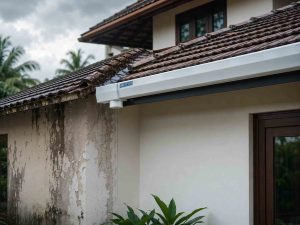
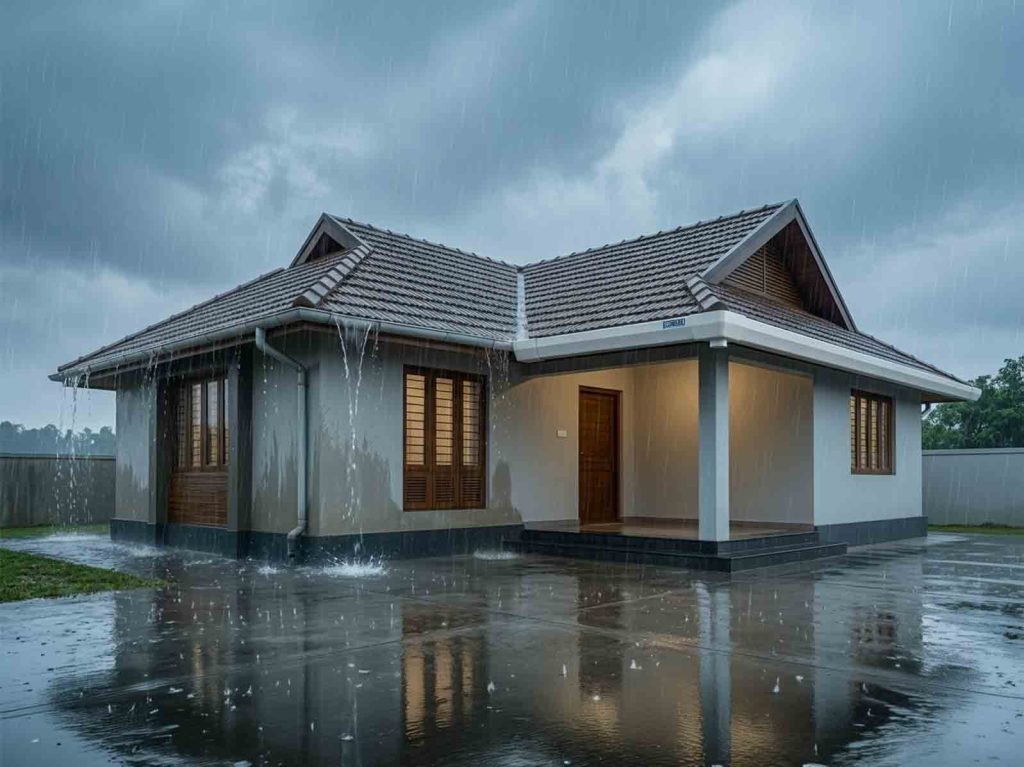
It doesn’t take an extreme weather alert to flood your basement, ruin your porch, or send moisture seeping through your living room walls. Even a gentle, steady afternoon drizzle can cause thousands of rupees in water damage if your home’s drainage framework is flawed.When a house experiences flooding or structural dampness during ordinary rain, the issue isn’t the volume of water falling from the sky; it is how that water is being managed once it hits your roofline. Most localized household flooding starts simply because rainwater isn’t being efficiently captured and directed away from the building’s core structure.
The primary defense mechanism against water accumulation is your Rainwater Gutter System for Homes.. However, this system is highly vulnerable to a silent killer: organic debris blockages.Throughout the dry summer months, winds deposit dust, dry leaves, twigs, and bird droppings onto the roof. When the first rains arrive, this debris is swept down into the gutter channels. If your gutters lack proper flow dynamics, this material doesn’t wash away; it accumulates at the downspout entry points, forming an impermeable organic plug.
When a gutter chokes, the water has nowhere to go. Within minutes of a moderate shower, the channel fills to capacity. The water then spills over the edges in two destructive directions:
Even when gutters are entirely free of debris, they can still overflow during minor rains if their architectural shape and sizing are incorrect. Many homes across Kerala suffer from what is known as roof-edge overshoot. When water flows down a sloped roof tile or a corrugated metal sheet, it builds momentum. If the installed gutter profile is too shallow or narrow, the water leaves the edge of the roof at a trajectory that skips right past the outer lip of the channel.
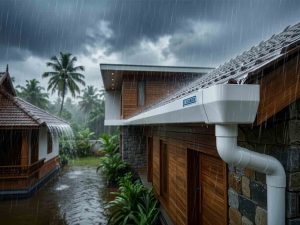
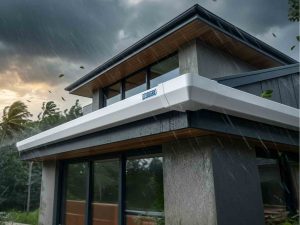
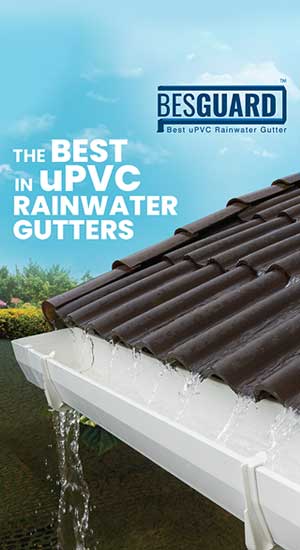
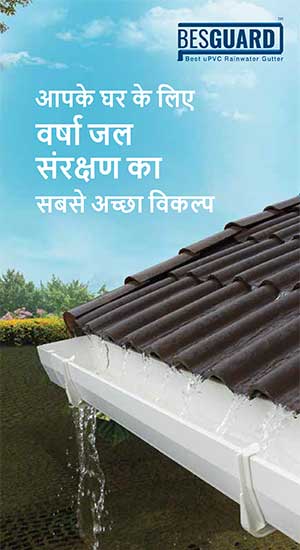
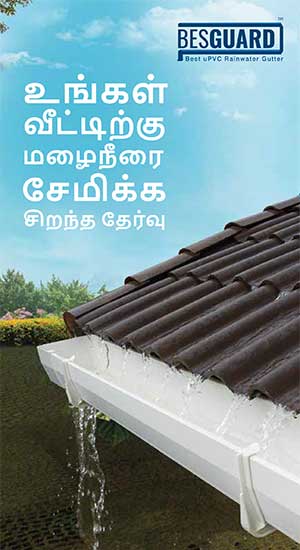
Standard round or square gutters often lack the depth to handle this velocity, turning a minor rain shower into an uncontrolled waterfall.To prevent this, modern sustainable architecture relies on advanced trapezoidal gutter designs, such as those engineered by Besguard. The wider, flared opening of a trapezoidal profile creates a larger target zone that safely catches high-velocity runoff, while its deep, narrow base rapidly accelerates the water toward downspouts before it can pool and overflow
What happens to all that overflowing water cascading off your roof edges? Rainwater Gutter System for Homes directly at the base of your exterior walls. This brings us to the most dangerous and expensive drainage mistake a homeowner can make: failing to direct water away from the foundation.
The soil surrounding your home acts like a sponge. When water drops directly from the roofline to the base of the house rather than being channeled safely into a storm drain or rainwater harvesting system, the ground becomes saturated. This leads to several severe structural issues:
As the soil becomes waterlogged, it creates immense hydrostatic pressure against your home’s foundation footings and sub-flooring. This pressure forces water through microscopic pores, hairline cracks, and construction joints in the concrete. Suddenly, you find water mysteriously bubbling up through your ground-floor tiles or dampening your basement walls, even though the surrounding street is completely dry.
When soil undergoes repeated cycles of extreme saturation and drying due to uncontrolled roof runoff, it expands and contracts unevenly. This movement causes the ground beneath your footings to shift, leading to differential settlement. The visible result? Structural stress cracks are ripping diagonally across your exterior and interior brickwork.
Most localized flooding and dampness issues are entirely preventable. Homeowners often inadvertently create their own water management crises through a few common maintenance and construction oversights:
Choosing thin-walled, cheap plastic or poorly fabricated tin gutters to save on initial costs is a major misstep. These systems lack structural integrity; they bow, warp, and sag under the weight of even moderate water loads. When a gutter sags, it creates a localized low point where water pools, breeds mosquitoes, and spills over long before reaching a downspout.High-performance uPVC gutter systems solve this by incorporating an Internally Reinforced Rib (IR-Rib) design. These internal ribs provide the rigid support needed to keep the channel straight and perfectly aligned, ensuring optimal gravity-fed drainage without unsightly external metal brackets that spoil your home’s exterior design.
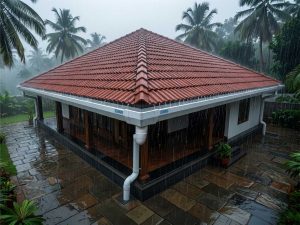
A downspout’s job isn’t finished when it brings water down to the ground level. Discharging water directly at the base of the wall simply concentrates the flooding threat right next to your foundation. Downspouts must always terminate into an enclosed drain, a dedicated rainwater harvesting tank, or an extension pipe that deposits the water at least three to five feet away from the building perimeter.
In tropical regions like Kerala, building materials endure brutal temperature swings, moving from baking daytime heat to cool rainy nights. Cheap gutter joints crack under this constant expansion and contraction, creating persistent leaks that drip down and rot the house’s exterior plaster. Premium rainwater systems feature heavy-duty rubber seals and dedicated expansion zones within their joints to absorb this physical movement safely, maintaining a completely watertight seal for decades.
To see how the choice of materials directly impacts your home’s vulnerability to flooding and moisture intrusion, consider the differences below:
| Architectural Feature | Substandard / Local PVC Systems | Engineered Premium uPVC Systems (e.g., Besguard) |
| Profile Geometry | Shallow round/square; high risk of water overshoot. | Trapezoidal canal design maximizes catchment and accelerates flow. |
| Structural Integrity | Prone to sagging, warping, and bending under water weight. | Internally Reinforced Ribs (IR-Rib); holds heavy water loads without deformation. |
| Joint Reliability | Glued or poorly sealed joints that crack during thermal shifts. | Heavy-duty rubber-sealed overlap joints that accommodate thermal movement. |
| Visual Aesthetics | Clunky external brackets that rust and ruin your home’s facade. | Concealed internal joints; preserves clean, modern architectural lines. |
Protecting your home from flooding doesn’t require complex engineering or massive flood walls; it starts with fixing how your roof handles common, everyday rainfall. By replacing old, clogged, or undersized gutters with high-capacity, structurally reinforced trapezoidal uPVC profiles, you eliminate water overshoot, shield your foundation from water logs, and stop internal dampness before it can start.
Don’t wait for a severe storm to reveal problems in your Rainwater Gutter System for Homes. Take a close look at your roofline during the next moderate rain, fix the weak spots, and ensure your home stays dry, safe, and solid for the future.
To better visualize how an engineered drainage layout effectively moves water under pressure, take a look at this detailed overview of a modern rainwater harvesting assembly. This system demonstrates how heavy-duty profiles capture and guide intense runoff safely away from your home’s structural walls.