Monsoon Alert Kerala 2026: Is Your Roof Ready for Heavy Rainfall?



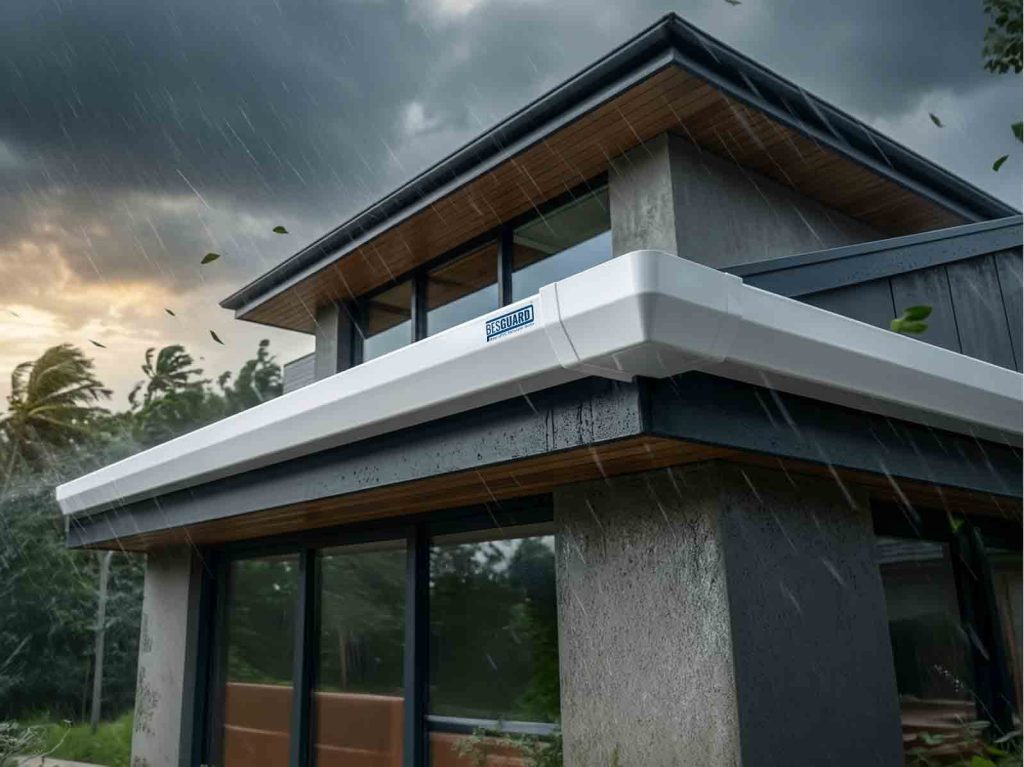
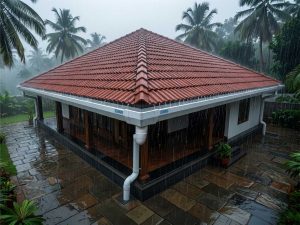
The monsoon season in Kerala is changing. While the region has always been accustomed to predictable, steady rainfall, recent climate shifts have brought a noticeable increase in intense weather events. Monsoon depressions originating in the Arabian Sea and the Bay of Bengal frequently trigger torrential downpours accompanied by fierce, howling winds,increasing the demand for durable uPVC Gutters for Heavy Rain in Kerala homes.
During these intense periods, rain rarely falls straight down. Instead, it hits our homes horizontally – what engineers and homeowners call sideways rain.
When wind-driven rain slams against your house, your entire roof and wall infrastructure is put to the ultimate test. While much attention is paid to the strength of roofing sheets or the waterproofing of concrete slabs, one critical component is routinely overwhelmed: the gutter system.
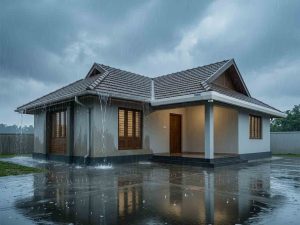
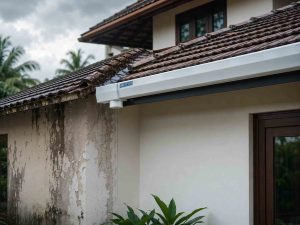
Look around your neighborhood during a severe thunderstorm, and you will likely see water overshooting gutters entirely, cascading like a waterfall onto the porch, washing away landscaping, and soaking directly into exterior plaster. If your rainwater management system is undersized or poorly designed, a severe storm won’t just cause a minor overflow – it can actively threaten the structural integrity of your home.
To understand why standard gutters fail during a storm, we must examine the physics of wind-driven rain. In calm weather, a gutter only needs to collect the water falling directly onto the horizontal footprint of the roof surface. But when strong winds enter the equation, two problematic phenomena occur:
When a gutter cannot contain this high-velocity flow, water overshoots the front lip. This isn’t just an aesthetic nuisance. The resulting overflow causes severe splash-back against your exterior walls, stripping away premium paint, creating a breeding ground for dangerous black mold, and initiating the slow, destructive process of concrete carbonation and structural dampness.
A common topic in community discussions and local construction forums across Kerala is the premature failure of home exteriors. Homeowners frequently complain about damp interior walls, stained elevations, and leaking foundations just a few years after construction. In a shocking number of cases, the root cause is an undersized gutter design.increasing the need for durable uPVC Gutters for Heavy Rain in Kerala homes.
Many traditional construction projects treat rainwater gutters as an afterthought – an inexpensive plastic or aluminum channel slapped onto the fascia board at the end of the project. This neglect manifests in several critical design flaws:
Most off-the-shelf plastic gutters feature a shallow, semi-circular profile. While adequate for gentle showers, these profiles lack the cross-sectional depth to handle sudden cloudbursts,increasing the importance of durable uPVC Gutters for Heavy Rain. When water enters the gutter faster than gravity can pull it toward the downspout, the gutter chokes, fills to the brim, and spills over backward toward the wooden or concrete fascia board, rotting the roof framework from the inside out.
Water is heavy, weighing exactly one kilogram per litre. During a tropical depression, a gutter line can hold hundreds of kilograms of fast-moving water simultaneously. Standard gutters rely on external PVC or flimsy metal brackets spaced too far apart. Under the immense weight of the water and the physical buffeting of strong winds, these brackets flex, causing the gutter to sag. These sags create stagnant pools of water that breed mosquitoes and cause the entire system to warp out of alignment.
Climate resilience requires us to design our homes not for an average sunny day, but for the worst-case weather scenarios. This is where the concept of Capacity Design becomes vital. Your rainwater management system must be engineered as a complete, cohesive unit capable of capturing, containing, and channeling high-velocity, wind-driven water.
When analyzing high-performance rainwater systems tailored for tropical climates – such as the solutions manufactured by Besguard – several architectural innovations stand out as absolute necessities for modern Kerala homes:
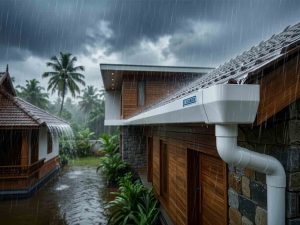
To combat sideways rain overshooting the roofline, a gutter needs a wider opening and a deeper base. Advanced uPVC gutters utilize a mathematically optimized trapezoidal design. The flared outer lip acts as a wide-mouth catchment zone that captures horizontally blowing water sheets, while the narrower, deeper base accelerates the flow velocity toward the downspouts. This geometric shape handles significantly higher volumes of water than a standard round gutter of the same width.
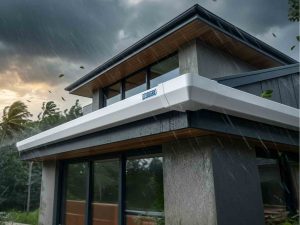
External brackets are vulnerable to wind shear and heavy load deformation. Premium systems solve this by incorporating an Internally Reinforced Rib (IR-Rib) structural design. The reinforcement is built directly into the inner profile of the uPVC channel, providing immense rigid strength that resists bowing, twisting, or sagging under maximum water loads. Furthermore, by using concealed internal joints and brackets, the external facade remains completely clean, preserving the premium architectural elevation of modern luxury homes.
Kerala’s climate features extreme thermal shifts – transitioning from scorching 38°C summer heat to cool monsoon downpours. These temperature swings cause building materials to expand and contract. Flimsy gutter joints crack under this physical stress, leading to persistent leaks. High-capacity engineering utilizes robust, heavy-duty rubber seal components and secure overlap joints that absorb this thermal movement without losing their watertight seal.
To understand the economic value of proper capacity design, consider a real-world scenario common to many Kerala households during a monsoon depression. Imagine a beautifully designed two-story contemporary home in Ernakulam or Kozhikode. The homeowner invested heavily in premium texture paints and a structural glass facade. However, to save a small amount on the initial budget, standard 4-inch thin-walled PVC gutters were installed along the roof perimeter instead of durable uPVC Gutters for Heavy Rain.
During a midnight storm with wind speeds reaching 50 km/h, the sideways rain shoots right over the shallow gutters. The water pounds against the exterior walls, finding its way into microscopic plaster hairline cracks. Within forty-eight hours:
The cost to repair the plaster, re-waterproof the walls, and repaint the exterior can easily run into lakhs of rupees. In comparison, investing in a heavy-duty, professionally engineered uPVC rainwater management system from the start costs a fraction of that amount, offering permanent protection against the elements.
A home is the most significant financial and emotional investment most families will ever make. Protecting that investment requires anticipating the realities of changing weather patterns. Sideways rain and intense monsoon depressions are a regular feature of Kerala’s climate, and our architectural choices must adapt accordingly.
When planning or upgrading your roofing system, do not settle for substandard, under-designed gutters. Look for heavy-duty, UV-stabilized, trapezoidal uPVC profiles like those engineered by Besguard, which combine immense structural strength with superior water-carrying capacity. By implementing an advanced, wind-resistant rainwater system, you ensure that no matter how hard the wind blows or how fast the rain falls, your home remains dry, secure, and beautiful for generations to come.