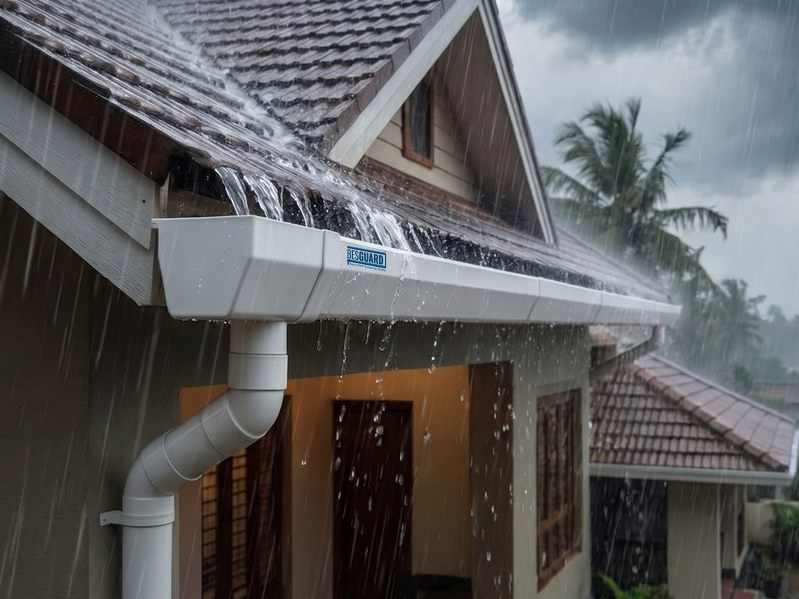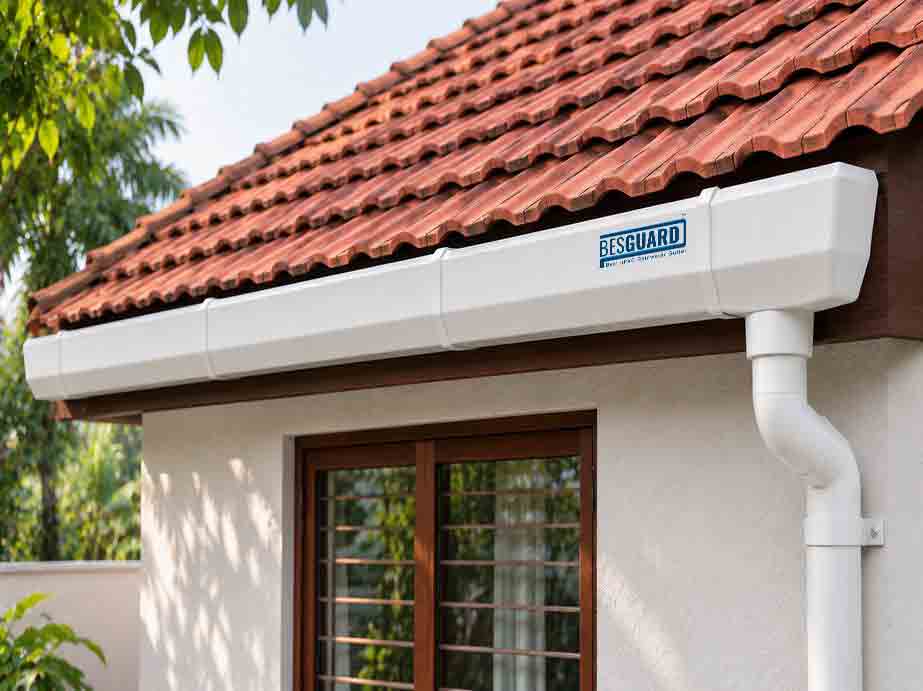
Besguard uPVC rainwater gutters use IR-Rib internal reinforcement, which adds stiffness to the gutter so it holds its shape when heavy monsoon rain pours through it. A gutter that stays straight keeps its slope, keeps its joints tight, and keeps the water moving toward the downpipes instead of spilling over the edge.
Most homeowners never think about the inside of a gutter. They notice it only when it fails: a section sags, a joint opens, or water pours over the front during a storm. Those failures usually start with the gutter bending under load, and that is exactly the problem IR-Rib reinforcement is designed to resist.
This guide explains what the reinforcement does, what happens to a gutter without it, and what to check when you buy a gutter for your own home.
A gutter does more than catch rain. During a heavy monsoon shower it carries a large volume of water along its length while leaves, silt and sometimes ladders, branches or people's weight press down on it. Over time, a thin or weakly supported gutter can:
A gutter that does any of these things is not doing its job, even if it looks fine from the ground.
IR-Rib is the internal reinforcement built into Besguard's uPVC gutters. The ribs add structure inside the profile, giving the gutter extra rigidity along its length. You can think of it as the difference between a flat sheet of paper and a folded one: the fold adds strength without adding much weight.
The reinforcement works alongside the outer profile, which is available in 165 mm and 225 mm sizes. The profile sets how much water the gutter can carry, and the reinforcement helps it keep that shape when the water is flowing hard.
When a gutter carries heavy flow, three things matter: it should stay straight, keep its fall, and keep its joints sealed. IR-Rib supports all three.
The result is a gutter that works the way it was designed to, storm after storm.
Choosing the right profile size is only half the job. Our gutter sizing guide explains how to match the gutter to your roof area and downpipe count. But a correctly sized gutter that sags will still overflow, because the water is no longer reaching the outlets.
Reinforcement and sizing work together. The size sets the capacity, and the reinforcement helps the gutter deliver that capacity in practice, even when it is loaded with water and debris.
Not every uPVC gutter is built the same way. When you compare options, ask:
A reputable supplier will answer these questions clearly. If the answers are vague, look elsewhere.
Besguard supplies uPVC rainwater gutter systems in 165 mm and 225 mm profiles, with IR-Rib reinforcement and a 10-year warranty. Explore the range on our Besguard homepage, or see the individual product pages for the 165 mm profile and the 225 mm profile.
For installation guidance, read our installation process, and for common mistakes that cause sagging and overflow, see common rainwater gutter installation mistakes.
A gutter does its job only when it stays straight, keeps its fall and keeps its joints sealed. Besguard's IR-Rib reinforcement is built to help with all three, so the gutter keeps moving water toward the downpipes during the heaviest rain. Pair it with the right profile size and correct installation, and it will handle the monsoon far better than an unreinforced gutter.